The Air Fryer That Feels Like a Kitchen Appliance
If you’ve looked at air fryers, you know the choice isn’t between “good” and “bad.” It’s between a gadget that lives on your counter, announcing itself with aggressive styling, and an appliance that quietly does its job. The Chefman model with the touchscreen and “Air Fry+” technology falls decisively in the latter camp. It’s for the person who wants the function of air frying without the aesthetic of a spaceship parked next to the toaster.
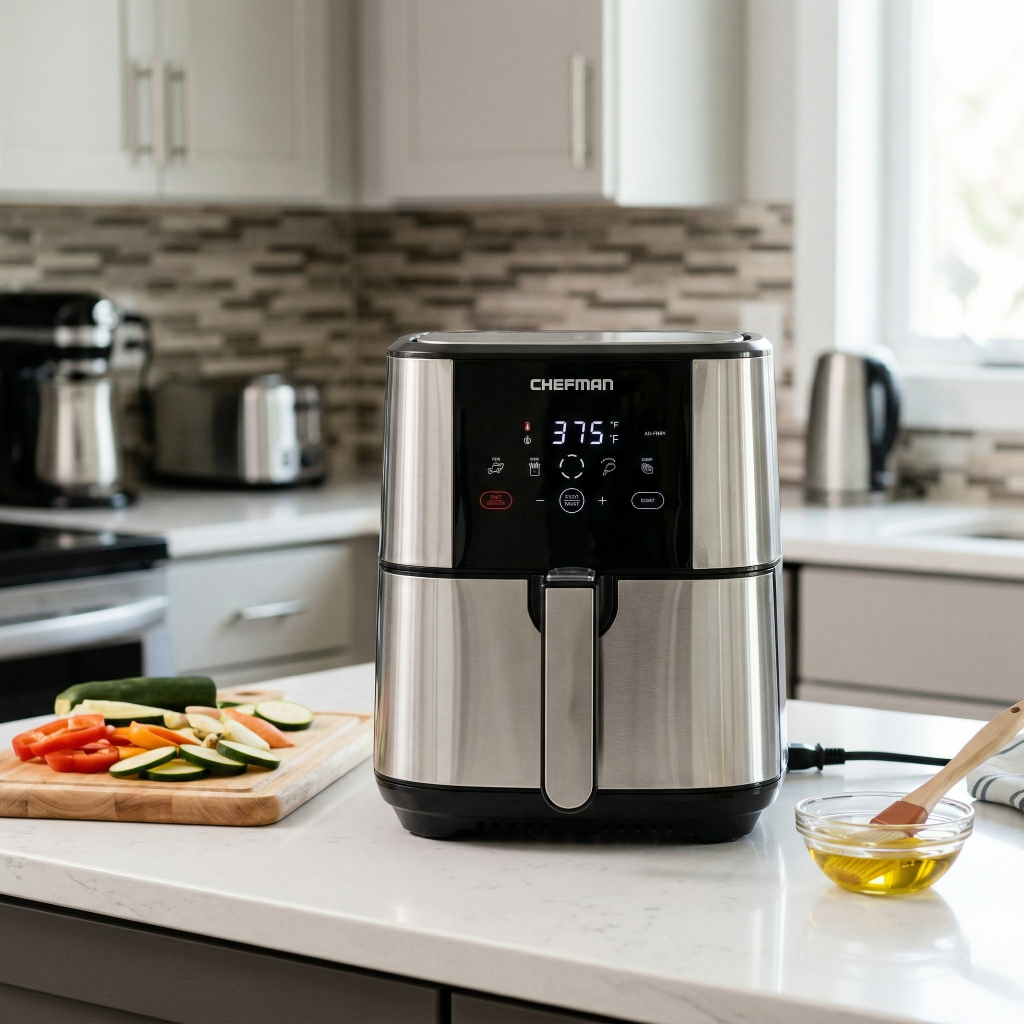
Most people get air fryers wrong by thinking they’re just for fries and frozen snacks. The real test is how they handle the mundane: reheating last night’s roasted vegetables without turning them to leather, or crisping the skin on a single chicken thigh without needing to heat the entire oven. This is where a fryer’s control and consistency matter more than its max temperature.
Where This One Gets the Details Right
The touchscreen isn’t just for show. It’s a flat, sealed glass panel, which means wiping down the front of the fryer takes one pass with a damp cloth—no greasy crumbs getting stuck in physical button crevices. After months of use, this feels like a minor design triumph. The basket, too, has a thoughtful heft. The exterior finish is a matte, dark grey that resists fingerprints better than the common glossy black, and the overall shape is a vertical rectangle that tucks more easily against a backsplash.
Its performance is steady, not explosive. It won’t cook frozen french fries 30 seconds faster than a cheaper model, but it will cook them more evenly, with fewer pale, soggy ones hiding at the bottom of the basket. The “Air Fry+” setting seems to modulate the fan speed, which results in less “blow around” for lighter foods like broccoli florets. You won’t open the basket to find all your seasoning plastered against the back wall.
The Two Specific Quirks You’ll Discover
First, the preheat alert. It beeps when it thinks it’s reached temperature, which is fairly quick. In practice, I’ve found giving it another 60-90 seconds beyond the beep leads to much more consistent results, especially for anything you want to start with a serious sear, like marinated tofu or sausage. It’s a minor ritual to learn.
Second, the basket handle has a cool-touch coating that works very well, but the release button is a firm, long press. It’s not a flick. This is clearly a safety feature to prevent accidental spills, but it requires a deliberate thumb push all the way in. If you have any hand strength or dexterity issues, you’d want to test this. On the flip side, it feels utterly secure and never once has the basket disengaged unexpectedly.
The Tradeoff for That Clean Look
The tradeoff for the sleek, integrated touchscreen is absolute: if the panel fails, the unit is a brick. There’s no manual override, no physical dial as a backup. You are placing your faith in that single electronic interface. So far, it’s been flawless, but it’s the kind of long-term consideration a cheaper unit with knobs doesn’t present.
What you might regret not knowing is that while the capacity is listed at a generous volume, its optimal performance zone is when the basket is no more than two-thirds full. Pushing it to its max capacity will work, but you’ll need to pause and shake midway through, and the results won’t be as uniformly crisp. It’s better to think of it as a high-performance tool for 1-3 people, not a batch-cooking machine for a large family.
It ends up being the air fryer you don’t think about. It doesn’t have a cult following or a catchy name. It just reliably turns out crispy chickpeas, revives pizza, and cooks salmon fillets with a perfect crust, all while looking like it belongs. Its greatest strength is also its most subdued: it feels less like a trend and more like a permanent, useful part of the kitchen.