The HotKing Dual-Zone Oven: For When You’re Done Playing Kitchen Tetris
If you’ve ever juggled a sheet pan of roasted vegetables and a tray of frozen fries in a standard toaster oven, or tried to air fry chicken while toasting garlic bread, you know the problem: most countertop ovens are single-taskers. You either cook sequentially (cold fries, burnt bread) or fire up the big oven for a single serving, which feels wasteful. The HotKing 28QT isn’t just a bigger air fryer toaster oven. It’s an attempt to solve that sequencing problem by giving you two independently controlled cooking zones. After using it for several weeks, the real story isn’t just the feature list—it’s about whether this novel layout changes how you cook on a Tuesday night.
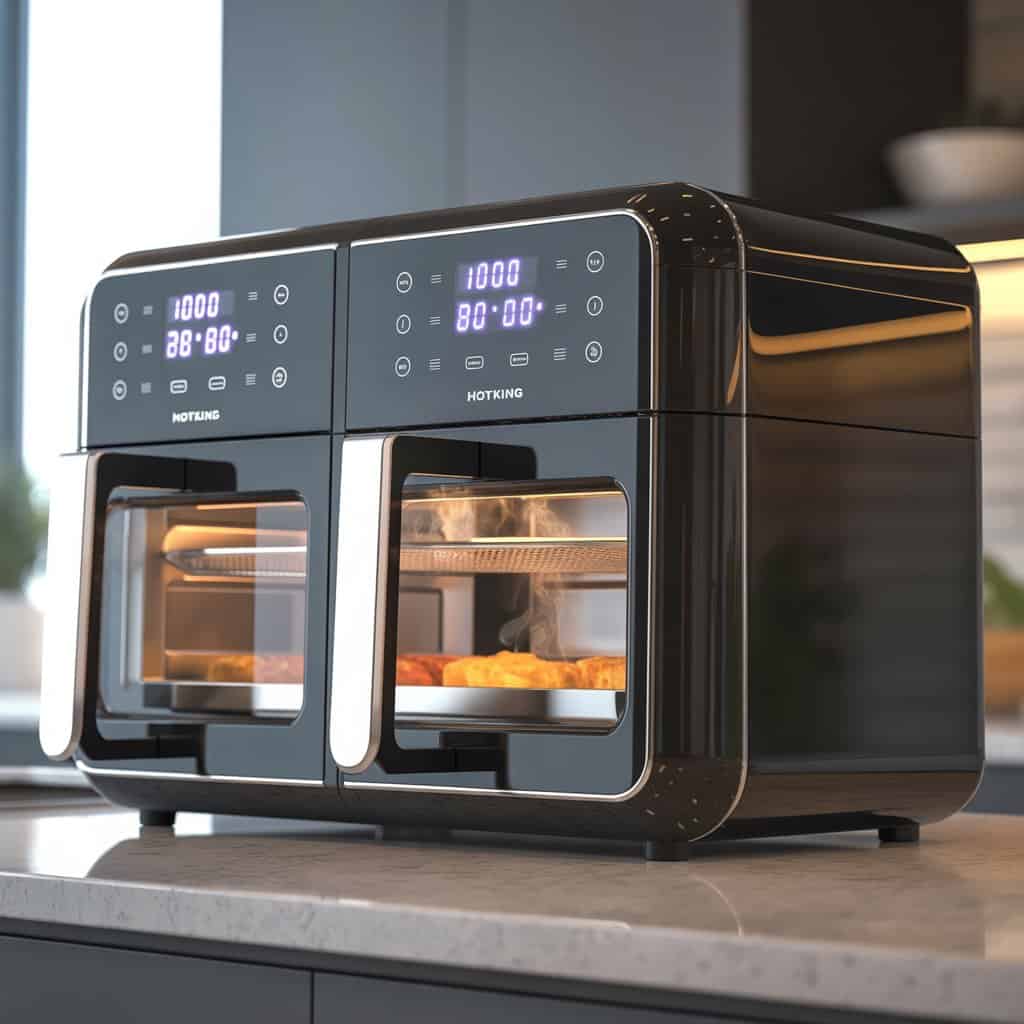
The Dual-Zone Reality: Sync is the Secret
The marketing focuses on “dual-zone,” which sounds technical. In practice, it means the oven has two heating elements and fans that can be controlled separately, divided by a removable metal partition. You can, indeed, air fry chicken wings on the left at 400°F while proofing dough on the right at 80°F. But the killer feature isn’t just doing two different things—it’s the SYNC function.
Here’s what most people get wrong: they think dual-zone is only for cooking two entirely separate dishes start-to-finish. That’s possible, but the real efficiency win is for a single meal with components that need different temps or times. For example, you can sync the zones so that your salmon fillets (set to roast at 375°F for 15 minutes) and your asparagus (set to air fry at 400°F for 10 minutes) both finish at the same moment, automatically. The oven handles the staggered start times. This is where it moves from a novelty to a genuinely useful tool for anyone who regularly cooks multi-component meals from scratch.
The Build and The Quirks
The all-stainless steel interior feels solid and cleans easily, a step up from the non-stick coatings in many competitors that can degrade. The French doors are a delight—they take up half the forward clearance of a swinging door, a crucial detail for shallow counter depths. You can stand directly in front to baste or turn food.
However, there are two specific, physical quirks you should know:
1. The Window is Mostly for Atmosphere. The interior window is smaller than you’d think, and during active air frying or roasting, it quickly fogges over with condensation. Don’t buy this expecting to visually monitor browning. You’ll still be opening the door (which, thanks to the design, is quick and doesn’t blast your face with heat). 2. The Rotisserie is a Commitment. The spit is heavy-duty and works well for a small chicken. But setting it up requires removing both cooking racks and the center divider. It transforms the oven into a single, rotisserie-only chamber for that session. It’s not a side feature you use while baking something else; it’s a main event. Plan accordingly.
What It Does Unusually Well (and One Thing It Doesn’t)
Exceles at: True, high-heat convection. The 500°F setting with the dual fans is legit. This is where it surpasses many smaller, plastic-housed air fryers. You get exceptional crisp on roasted potatoes, blistered pizza crust, and properly dehydrated jerky strips without the hot spots common in bucket-style air fryers. The 28QT capacity is also honest—you can fit a 12-inch pizza or six generous slices of toast without crowding.
The Trade-off: Size and speed. This is a substantial appliance (about the footprint of a large bread machine). It also has a significant preheat time, especially to reach higher temps. If you just want to reheat two slices of yesterday’s pizza, your old pop-up toaster or a microwave will be faster. This isn’t for instant gratification; it’s for cooking. The value comes when you use its capacity and dual-zone ability to replace multiple steps that would have used your main oven.
Who This Is Actually For
This isn’t a first-time air fryer buyer’s appliance. It’s for someone who already understands the utility of countertop convection and has hit the limits of their current device. Think: a household of 2-4 that cooks most meals at home, enjoys from-scratch components (protein + veg + starch), and is frustrated by either the single-batch limitation of a standard air fryer or the energy inefficiency of heating a full-sized oven for small meals. It’s also a natural fit for anyone with a small kitchen lacking a full-sized oven, or for summer cooking when you want to avoid heating the house.
The person who buys this should be ready to use presets as a starting point but willing to tweak times and temperatures. Like any powerful convection oven, it can go from perfectly golden to just a bit too dark quickly on its default settings. Your attention is still required.
The One Thing You’d Regret Not Knowing
Before buying, you must check the clearance behind your counter. While the French doors save space in front, the rear houses the large convection fans and heating elements. The manual insists on 5 inches of clear space at the back for adequate ventilation. Pushing it flush against the backsplash or cabinets is a recipe for overheating and poor performance. This isn’t a unit you can tuck into a tight cubby.
The HotKing Dual-Zone succeeds by rethinking the countertop oven as a miniature, intelligent kitchen center rather than just a toaster with ambitions. Its value isn’t found in any one function, but in the gradual realization that you’re no longer planning your cooking around a single, linear hot box.