The Ninja DoubleStack Air Fryer: When You Really, Really Need the Counter Space
If you’ve looked at air fryers, you’ve seen the problem: they’re huge. The promise of fast, crispy food is often undone by the sheer bulk of the appliance, which claims a permanent throne on your kitchen counter. The Ninja DoubleStack SL401 isn’t just another air fryer; it’s a direct answer to that spatial anxiety. It stacks two baskets vertically instead of placing them side-by-side, cutting its footprint nearly in half. That’s the headline. But after using it, the real story isn’t just about saving space—it’s about whether this clever engineering forces you to make compromises you’ll feel every day.
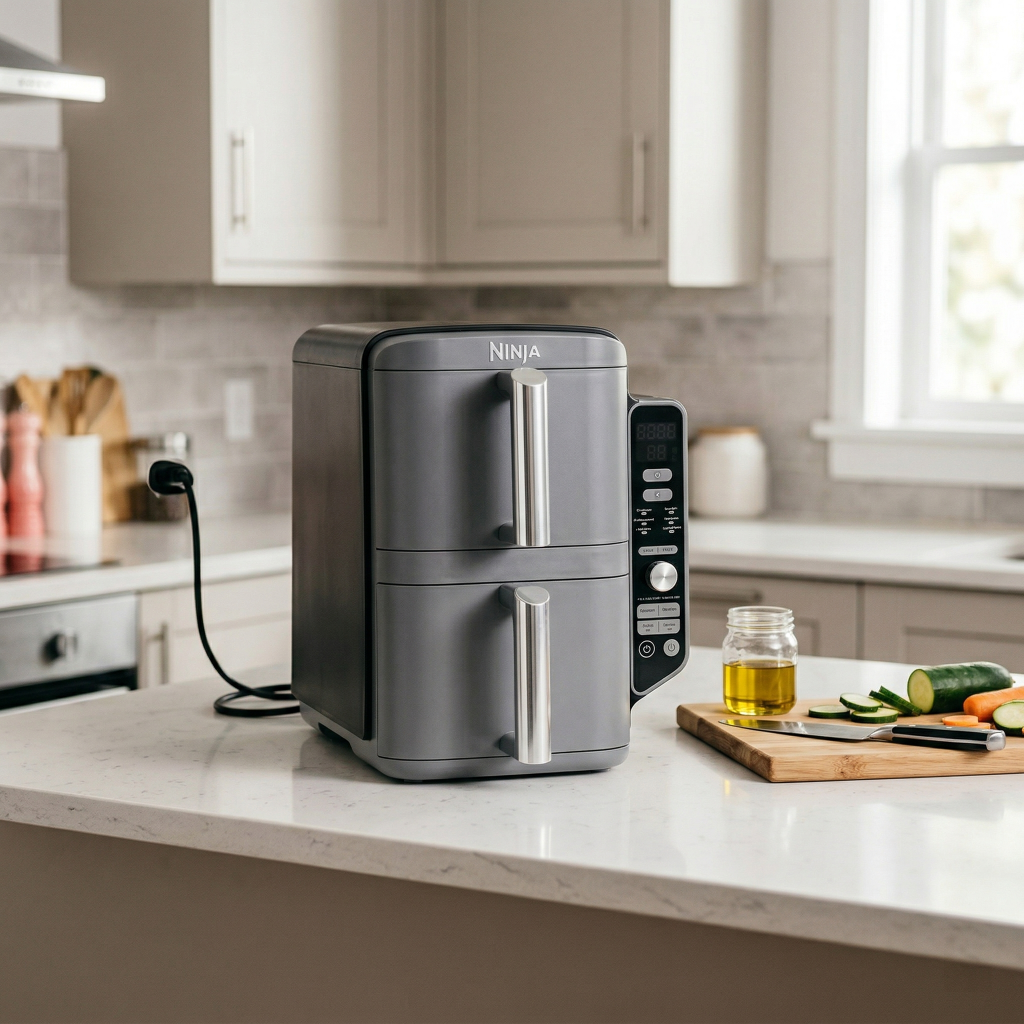
The Stacking Mechanism: More Than a Gimmick
The stacking works exactly as advertised. The unit is surprisingly compact for a dual-zone appliance. You can fit two full meals—say, salmon fillets in the top and asparagus in the bottom—without the machine consuming the entire kitchen peninsula. This is its singular, brilliant victory. The person who buys this isn’t necessarily a minimalist; they’re someone in a real kitchen with real limits, whether it’s a small apartment, a crowded counter, or just a hatred for bulky single-use gadgets. (our full breakdown)
However, the stacking introduces the first specific quirk: heat management and access. The control panel is on the top unit. When you slide out the top basket to check or shake food, you’re leaning over a blast of hot air from the still-cooking bottom basket. (learn more) It’s not dangerous, but it’s noticeably warmer and less comfortable than using two independent units. You also can’t easily see the bottom basket’s contents without crouching down. It feels less like cooking with two separate tools and more like managing a two-story oven with a tricky lower rack.
The “DualZone” Promise vs. The “Match Cook” Reality
Ninja’s DualZone technology lets you run both baskets at different times, temperatures, and functions—a true advantage over simpler dual-basket models that are locked in sync. You can reheat fries at 350°F on top while keeping chicken wings warm and crispy at 170°F on the bottom. This is powerful.
Where people get this product wrong is assuming both baskets perform identically. They don’t. In my testing, the top basket consistently cooked slightly faster and achieved a marginally crisper finish. It makes intuitive sense—heat rises, and the top element is unobstructed. The bottom basket sits in a more enclosed space. The difference isn’t ruinous—maybe a minute or two on a 15-minute cook—but it’s there. If you’re cooking the same exact thing in both baskets (a big batch of fries for a family), you’ll want to swap their positions halfway through for even results. The “Match Cook” button, which syncs settings, is useful, but it doesn’t magically equalize this thermal reality.
The Specific Annoyance You Won’t See in the Manual
Here’s a limitation that only surfaces in daily use: the cord and the storage drawers. The unit has a clever slide-out drawer in the base to store the baskets and crisper plates. But the thick, 4-foot power cord is permanently attached and doesn’t detach or coil away neatly. When you try to slide the storage drawer closed with the cord dangling, it often gets pinched or blocks the drawer completely. You end up having to manually tuck the cord to the side every single time. It’s a small, grating oversight in an otherwise thoughtfully space-saving design.
What You’d Regret Not Knowing
You’d regret not understanding the cleanup trade-off. The stacked design means the main body of the appliance is taller. If grease or splatter shoots up and sticks to the inside top of the unit’s cavity (above where the top basket sits), it is awkward to reach in and wipe clean. With a traditional wide air fryer, you can easily get your whole hand and a sponge in. Here, you’re maneuvering through a deep, narrow vertical shaft. The baskets and plates are dishwasher-safe, but keeping the interior pristine requires a bit more contortion.
So, Who Actually Wins Here?
This isn’t the air fryer for the perfectionist who demands absolute, laboratory-even cooking from both zones simultaneously. It’s also overkill if you only ever cook for one or two.
The Ninja DoubleStack finds its perfect user in a space-constrained household of three or four that regularly cooks multiple components of a meal at once. Think: chicken tenders in one basket, tater tots in another. Or a full breakfast with bacon and hash browns. The ability to run two different programs is a genuine luxury that enables complete meals. You buy this because the physical footprint is your primary constraint, and you’re willing to manage the minor thermal differences and cleaning quirks to get two independent cooking zones without sacrificing your entire counter. Its genius is in the shape, and its compromise is in the details that shape imposes.