The Typhur Wireless Thermometer: For When You Need to Know, Not Guess
If you’re looking at this, you’ve probably burned a roast, undercooked a chicken, or opened the oven door one too many times to check on things. You know that a good thermometer is the single most reliable way to improve your cooking. But you’re also tired of the old-school probe with the clunky wire that traps your oven door and feels like a relic from 2005.
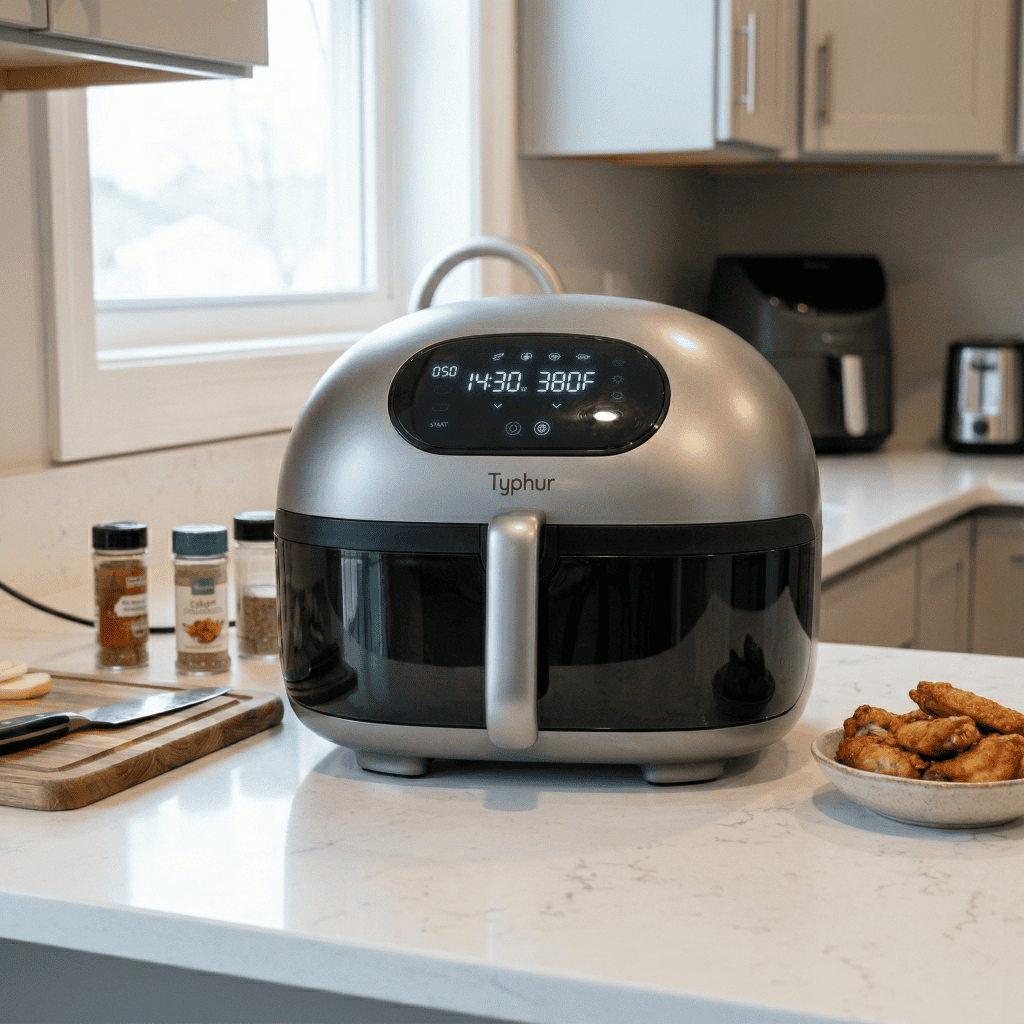
The Typhur Wireless Thermometer isn’t just an upgrade to that old corded probe. It’s a different tool for a different kind of cook. It’s for the person who values precision but hates fuss—the person who wants to set a target temperature for their brisket and then go watch the game in the other room, confident their phone will buzz when it’s time.
The biggest misconception people have about wireless thermometers is that they’re only for low-and-slow barbecue. That’s where the Typhur surprises you.
Where it quietly excels is in high-heat, fast-cooking scenarios. Most wireless probes have a cable that feels like an afterthought, but the Typhur’s probe has a noticeably robust, thick-gauge wire leading to the magnetic transmitter. This isn’t a flimsy thread; it feels built to be manhandled in a searing hot pan or jammed into a dense cut of meat. I’ve used it to monitor the internal temp of a steak while I sear it in a cast iron skillet hovering around 500°F, and the transmitter (which you clip to the pan’s side) never blinked. The app tracked the rise in real-time, letting me pull it for a perfect medium-rare the moment it hit 130°F, without a single poke-and-peek. It turns a high-stress, guesswork-heavy process into a calm, data-driven one.
The companion app is the other half of the product. It’s unusually polished and intuitive. You set your desired final temperature and, crucially, a “ready-to-serve” range (e.g., 130-135°F for medium-rare). The app shows a clear countdown and a real-time graph of the temperature climb. This is where you discover its best trick: the predictive timer. After a few minutes of tracking the temperature rise, it calculates an estimated time-to-completion. For a Sunday roast chicken, this feature is a game-changer for coordinating the rest of your meal. You’ll know it has 23 minutes left, not “somewhere between 15 and 30.”
But this precision comes with a specific, non-negotiable tradeoff: you must commit to using your phone. The transmitter itself has no screen. If your phone battery is dead or you leave it in another room, you are blind. This is the core bargain. For some, this is liberation—the phone becomes the remote monitor you can take anywhere. For others, it’s a point of failure. There’s no glancing at a base unit on the counter.
A few specific, tangible details you’d only notice after using it: * The magnet on the transmitter is strong enough to hold onto a fridge or range hood, but the included metal clip is what you’ll use 90% of the time. It feels substantial, like a heavy-duty binder clip. * The probe is long—over 5 inches of stainless steel. This is great for a large turkey, but for a single, thick-cut pork chop, it feels almost comically oversized. It works, but it’s overkill. * The “Dishwasher safe” claim is for the probe only. You’ll hand-wash the transmitter unit, which has a USB-C charging port covered by a small, fiddly rubber plug. Don’t lose that plug.
What you might regret not knowing is that while its range is excellent through walls and floors (as advertised), the signal can be interrupted by large metal appliances. If your kitchen is in the far corner of the house with a refrigerator and microwave between you and the living room, you might experience the occasional drop. It always reconnects, but it’s a reminder that physics still applies.
This isn’t the thermometer for every kitchen. If you just want a quick-read for checking burgers, a Thermapen is faster and simpler. But if your cooking has evolved to the point where you think, “I wish I could see the exact temperature curve of this roast as it cooks,” then the Typhur provides that data with a level of polish and reliability that makes the process feel less like babysitting and more like conducting a simple, foolproof experiment. It turns the anxiety of doneness into a notification on your lock screen.